Saturday, August 24, 2013

GenCon 2013

Last week I got back from GenCon. Here are some of the highlights.

Part 1: The Long Journey

My original plan was to leave on a flight from Denver at 6:00 AM going to Champaign, IL; this way I could spend a few hours in Champaign, and then take a bus to Indianapolis (it is about a 2 hour bus ride). However this plan didn't work because the flight from Denver was delayed until 12:30. Fortunately I explained to them what I wanted to do, and they saw there weren't any other flights to Champaign, but they rebooked me on another flight going from Denver to Detroit and then from there to Indianapolis. I was actually very surprised at how easy this was; I expected it to be a big problem that I wanted to go to someplace that wasn't on my original itinerary, and I expected to have to explain the story to several different people, pay an extra fee, etc. but that didn't happen. So it was a bummer that I didn't get to go to Champaign, but at least I ended up where I wanted to in the end.

Part 2: This Is A Test

At GenCon there was a "First Exposure Playtest Hall", where game designers bring prototypes of new games to playtest. The games are scheduled in two-hour slots, where you pick up a ticket for the type of game you want to play - each game is described with a brief blurb like "Super Hero Deck Building Game." I did a few of these and some of games I did included the following:

1. Board game based on Greek mythology - each player is a Greek hero and they run around the board completing quests. I liked the theme of this game, but didn't really like the "political" aspect - there are lots of cards that you play on other player's turns to interfere with them, so if everyone gangs up and plays all the cards on one player it is difficult to win.

2. Dungeon crawling game based on video games - this game was a game where you go through a dungeon and fight monsters, and the artwork style is based on those old "8-bit" video games (i.e. like the original Nintendo Entertainment System). I didn't really like this game, because it just didn't offer anything that dozens of other games where you go around and fight monsters don't.

3. Two player adventure game where one player is the hero and one is the villain - this game was very different than other ones. The way it works is that the hero chooses a random "adventure card" from a pile of several dozen, and each of those has 4 stages on it, and it is arranged in a "choose your own adventure" format so that the villain reads the card aloud, and the hero chooses which choice he wants to determine which encounter comes up at each stage. During these encounters the hero and villain both have powers they can use to try to win the encounter, and the winner gets rewards. After going through three different adventure cards there is a "boss fight" where encounters are drawn from a special boss fight deck, and best 3 out of 5 encounters wins. I thought this game was really cool and very different from other games.

Also the group that does this runs another convention called "Metatopia" later in the year, which is much smaller and is basically just playtesting. I haven't been to that one before, but I might go this year.

Part 3: Made in America

I also went to a seminar about board game manufacturing, titles "Why does your game cost so much to make?" Here are some interesting facts that I learned.

- If a game costs $X to make, the designer will usually sell it to distributors for $2X (to cover other expenses, taxes, profit, and the possibility of having unsold product). After you add in the distributor's markup (when selling to the retailer) and the retailer's markup, the game costs $5X to buy from the store.

- There are about 1,200 board game stores (I don't know whether that number is just in the US, or if it includes other countries). For a new game from a new designer, a store buying 3-6 copies of the one game is a lot.

- There are lots of factors that go into the price of a game, and smart designers will learn how the manufacturing process works to they can make changes that might make the game cheaper. For instance, cards are printed in "sheets" which usually have 110 cards. So if your game has 120 cards, that's not good because you're wasting most of the second sheet. So if you can get down to 110 cards, then you will only need one sheet. Also, many rulebooks will be a multiple of 16 pages because the rulebooks are printed on sheets 16 pages in size and then folded up.

- If the game is relatively low on the scale in terms of size of order, the printer will not ship it directly to the distributors. Rather, the printer will ship it to the designer (so the designer will either have to rent warehouse space, or store all those games in his garage) and then the designer will handle getting orders from the distributor and shipping them. I thought that this seemed like an inefficient process, and didn't really understand their explanation of why they did it that way.

- There are two different types of processes that designers can use. One is a "turnkey system" where the designer will hire one company to manage the production process including sourcing all the components and packaging them all together. This is the recommended method for new designers because it is easier. The alternative is for the designer to manage the process himself, including sourcing the different components (e.g. boxes from one company, cards from another company, little wooden pieces from a third company) and arranging for them to be shipped to one place and put together.

- One of the designers at the panel described the process as "just like any economic management board game that you've ever played, except it's more complicated, it's with real money, and there is no rule book, you have to figure it out as you go along".

Part 4: Report To The Bridge

A really cool game they had was called "Artemis: Spaceship Bridge Simulator." This is sort of a cross between a computer game and a LARP - it is a computer game where all the players are on the same team; they are a crew of a spaceship, kind of like on Star Trek. There are up to six players, each of which controls a different station, from a different computer (they are all networked together), and they are are in the same room. The different stations are as follows:

Captain - The captain does not have a specific station, but he is the one that orders the other players what to do, like "Go to warp factor 2," "Increase power to shields," or "Launch nuke at the enemy."

Helm - The helm controls the ship's movement. Since this game is based on Star Trek, it uses Star Trek physics rather than real physics. That means that you can only move in the direction you are pointing, so there is a lot of "dogfighting" where you try to get behind the opponent. You can also go in reverse, although only using the impulse engines and not the warp engines. Just be careful not to run into your own mine or be too close to your own nuke when it goes off.

Weapons - The weapons officer controls the photon torpedoes torpedo tubes and the phasers primary beams. Just like in Star Trek, he also has the ability to change the "beam frequency" of the primary beams to match the weakest "shield frequency" of the target. Also the weapons officer has a button he can push to raise and lower the shields. The helm officer does too, so it is important to be clear in advance who is responsible for the shields, so that when the captain orders the shields raised, you don't have both the helm and weapons officers pushing the shield button, thus turning the shields on and back off again.

Engineering - The engineering officer controls the amount of power going to each of the ship systems. Increased power makes that system perform better (again, just like in Star Trek) but too much power too fast can overheat and damage the system. The engineering officer can also control the "damage control teams" to repair damage.

Communications - The communications officer can communicate with other friendly and enemy ships in the sector. He can taunt enemies to get them to go after him, order the starbases to produce different types of torpedoes, and order friendly ships to help defend the starbases (The team wins if they destroy all the enemy ships, and loses if all starbases are destroyed or if their ship is destroyed.)

Science - The science officer controls the ship's sensors, and can scan enemies. The first scan gives basic information about what type of enemy it is (like "Kralien Dreadnought" or "Stage 3 Bio-Mech") and the second scan gives more detailed information, such as the shield frequencies, and sometimes additional "Intel", which includes things like "The captain is unmarried". When this item came up, at first I thought that it was just a random blurb that popped up to be funny, and wasn't relevant to gameplay. But actually it turned out it is, because one of the "Taunts" the communications officer can use is insulting the captain's wife, which obviously won't work in that case.

This game is really cool because it feels like Star Trek, except that you're in the show. Also there can be funny moments like this one, where I was the captain:

Captain: Go to warp factor 1.
Helm: Warp engines appear to be off-line.
Captain: Engineering?
Engineering: Engineering reports all systems normal.
Captain (looking back at the Helm screen): You're in reverse.

Part 5: For the Record

Another event at GenCon was "The Big Game", an attempt to set a Guinness World Record for most people playing in one board game at one time. This was a game of Settlers of Catan, and there were 1000 tickets sold (which all sold out) but only 922 people ended up coming. The way the game worked was that there were a whole bunch of specially designed boards put side by side to form a very long chain of islands, with two players per board. The dice rolls were generated by randomly choosing cards from a deck of 36 cards, one for each possible combination of two dice, and reshuffling once 31 cards have been drawn. (This ensures a roughly even distribution of rolls.) The dice rolls were projected up on a big screen, and you have 90 seconds to do each turn. The whole event laster about 3 hours, of which only about 1 hour was the actual game, most of the time was spent going through the line getting people signed up, explaining the rules, setting everything up, and finally, it was like the finale of the whole thing was the actually game. At the end of the game they gave us a code that we could use to order a "Certificate of Participation" from the Guinness World Records web site.

More coming soon...

Sunday, July 28, 2013

More math mistakes

According to a picture that is making the rounds on Facebook, Halliburton will make enough money to pay off a $200,000 fine in "just 23 seconds".

$200,000 per 23 seconds is $274 billion per year. The "23 seconds" number appears to come from an article in the Huffington Post:

http://www.huffingtonpost.com/2013/07/26/halliburton-fine_n_3659293.html

This article claimed it uses the 2012 revenue numbers. However, Halliburton's revenues are actually only about $28.5 billion per year:

http://www.halliburton.com/public/news/pubsdata/press_release/2013/Q412_Earnings_Release.pdf

Wednesday, July 17, 2013

News Quiz

55 of Colorado's 62 county sheriffs have joined a lawsuit against the Colorado state governor to block two recent gun bills, including one which bans high-capacity magazines that can hold more than 15 rounds. Which of the following is an actual legal argument that was used in the court filing?

1. The ban discriminates against people with disabilities, because people with disabilities are less able to reload weapons quickly in a self-defense situation.

2. The ban interferes with the First Amendment right to freedom of the press, because the definition of "high-capacity magazine" is so poorly worded that it could refer to newsmagazines more than 15 pages long.

3. The 2nd Amendment's "right to bear arms" literally refers to "arms powerful enough to kill a bear", and some species of bears native to Colorado are tough enough that they require more than 15 shots to kill.

4. The 2nd Amendment's "right to bear arms" is geared toward weapons that the public is familiar with, and the most common way the public becomes familiar with weapons is from movies and video games, most of which include weapons with more than 15 rounds of ammunition.

Friday, July 12, 2013

Missing the Target

Did you see the recent news story about the lawsuit against Target for racial discrimination?  Apparently they had a training document which the employees thought was offensive:

http://www.huffingtonpost.com/2013/07/09/target-multicultural-tips_n_3566873.html

I don't understand why the first three items (not all Hispanic employees eat tacos, wear sombreros or dance
to salsa music) would be considered offensive. It sounds like these items are saying that Mexicans DO NOT
always follow the stereotype. (For instance, it seems obvious that if the document said "Yes, all Hispanics
do all these things" then that would clearly been  even more offensive. It seems weird to me that it is possible for
a statement to be racially offensive AND for its exact negation to also be racially offensive.)

However, the other three items, as well as some of the other descriptions of the conduct involved, do seem to be
racially offensive. But the one part that did stick out to me is the item about "some Hispanics are undocumented
workers." And the context of this document is talking about other employees.

So Target is admitting to hiring undocumented workers? Isn't that illegal? I'm surprised none of the stories
picked up on that.

Wednesday, June 12, 2013

Increasing Your Stats

In my last post, I mentioned show how when creating a Dungeons and Dragons character, you have the ability to choose your character's strength, intelligence, dexterity, and so on. Unfortunately, it isn't that easy in real life - but that might be changing thanks to new technology. In a series of articles in Slate magazine (http://www.slate.com/articles/health_and_science/superman.html),
The author discusses how new technologies and medical developments are enabling people to improve
human performance in a variety of areas. If you are interested, you should read the articles, I don't want to just repeat
them here. The article that was my favorite was "Spark of Genius", especially the link to the YouTube video and
the thing about the effect being reversed if you switch the positions of the electrodes. My general comments about
all of these ideas for human enhancement are as follows:

- Just to get this out of the way, I don't have any plans to try any of these on myself, so don't worry.
- Yes, some of these procedures may have long-term negative health effects. But there's lots of stuff we do that we
KNOW has long-term negative health effects (junk food, cigarettes) and there are no calls to outlaw those. So why
are there calls to outlaw human enhancement on that basis?
- A common argument against human enhancement compares it to the use of steroids in sports. But there is a very
important difference. Let's take, say, sprinting as an example. If by taking steroids I can run 5 percent faster, then
that is a huge advantage. If everyone takes steroids our relative ranking is the same, and it's not really significantly
more exciting to viewers, so nobody really benefits. If, in contrast, I can take some sort of cognitive enhancement drug to make myself do 
5 percent better in a test, and everyone does that, then yes, it's true that relative ranking doesn't change, BUT
now everyone learns 5 percent more, which is good. And considering the hundreds of billions of dollars we spend
each year in education, anything that improves learning even by a few percent could have huge economic benefits.
And, if the problem is that the drug makes you do better on the tests but doesn't improve actual learning, then that
is evidence that the tests don't measure actual learning, so a better approach would be to improve the tests rather
than blame the cognitive enhancement drug.)
- Another common argument against human enhancement is that it will increase inequality, because the poor won't
be able to afford it. However this argument seems seriously flawed to me:

--- 1. It is easy to come up with scenarios where enhancement helps the poor, rather than hurts it, even if only
the rich have access. For instance, let's say there are two classes of jobs, skilled and unskilled, and enhancement
moves some people from the unskilled to the skilled labor category. That increases the supply of skilled labor
relative to unskilled labor, and thus reduces the wage premium for skilled labor. Thus this could increase wages
even in the unskilled labor sector. Or let's say that scientists use cognitive enhancement on themselves, and that
makes them smart enough to invent a cure for cancer, then that will obviously benefit everyone, both rich and poor.

--- 2. There are lots of things that improve life outcomes that are more accessible to the rich than the poor
(good schools, access to educational resources, good role models, etc.). It would be silly to say that those should
be banned in the name of equality; rather, it makes sense to try to improve access so that the poor can have them too.
The same thing could be done with cognitive enhancement, if it works. And the problem of cheaply manufacturing
and distributing small electronic devices or synthesized chemical compounds (whichever enhancement method we
would want to use) is MUCH better understood than the other educational and social problems I mentioned.


(Of course, all of the above analysis assumes that the enhancement methods work long-term. That is still somewhat
speculative at this point, and if it doesn't work, then, well, it doesn't work, so no reason to use them.)

Dungeons and Dragons Part 1: "I am Domingo"

So, a couple weeks ago at the Haunted Game Cafe I met a group of three kids and we played a game of Catacombs (I was the Overlord). After the game they said they were interested in playing Dngeons and Dargons. So we agreed that next Saturday we would get together to create characters.

Theat day I went to the store and got a text saying that they weren't able to get a rids, so they wouldn't be able to come. I suggested that maybe we could meet somewhere else closer to them, and they said they were still looking, and maybe they could get a ride from someone else. In the meantime I went across the street to the mall to get some food. Wile I was there I got a text saying they had found someone else to take them, and were on their way. I finished my food and started walking back to the store, and while I was on my way (about 10 minutes after the text) saw that I had texts on my phone saying "Where are you" and "If you don't answer we are leaving." I had just assumed that they were much farther away than that, because they weren't able to come at all at first with no car (and the buses were running, so I assumed they were out of the bus service area as well). I texted him back saying "I am coming", but I spelled it wrong and the auto-correct corrected it to "I am Domingo". He said "what?" And I rushed back, and fortunately managed to get there before they left.

Anyway, with that resolved, we got into the actual character creation process. Only two of them were there but we started the process, and they made a warlock and a wizard. Some interesting things that happened were the following:

-They were well aware of how to exploit time inconsistency. When you determine your character's stats (strength, intelligence etc.) you have two choices. One choice is to roll dice, the other choice is to use a "point buy system" where you have a fixed number of points to allocate between the different stats. They chose the rolling method, knowing that if they really did roll poorly then there was no way I would actually be so mean and make them keep the poor rolls.

- It seemed like one of them wasn't interested as much in the fighting aspect. A few times during the session he asked if it was possible to negotiate with monsters rather than fight them, and even asked that question at the end when I set up a simple combat encounter not part of any actual adventure, just to show them how the combat worked.

- I am thinking that it may be a good idea to switch to a different role-playing game system. That is for a few reasons. First there are only three of them, and it seems likely that not all of them will be able to make it on any given day. The Dungeons and Dragons combat system is really designed for having at least four players to fill all the roles in the fight, and battles will likely be very tough with only two or three, especially since neither of the two characters they made had any healing or special defense abilities. 

- After this session I have been thinking about what to do for the actual adventure. One good source for adventure ideas, or ideas for things to put in the adventures, is the (real life) news, and I will tell you about what I have come up with when the time comes.

Sunday, September 23, 2012

SCA Artisan's Day

I have been looking more into the SCA over the past couple weeks to see what kinds of stuff they do. On Thursday this week I had planned to go to an archery practice and then to a group meeting at a restaurant. Unfortunately the person who had originally planned to pick me u pwasn't able to because he didn't have time; he had originally agreed to pick me up but then after I told him where my work was, he said it was farther away from the site than he originally thought. This was a bit surprising because I had showed him where it was on Google Maps before.

So I ended up skipping that part and just going to the group meeting. Most of the meeting was just about administrative stuff, which wasn't really that interesting. But I did get a chance to talk to some of the people there. They have people there that do a lot of interesting medieval-type stuff, including metalworking, embroidery, coin-making, and so on.

Yesterday I went to an SCA (Society for Creative Anachronism) event called Artisan's Day. This was a local event where we do arts and crafts stuff (the term the use for that is "Arts & Sciences", or "A&S".) I went because I was interested in seeing what kinds of stuff they made. We had a few things planned, including making apple cider, planning for woodworking projects, and learning medieval stories to tell. As it turned out, we had so much apple cider to make that we didn't get to the other stuff; we just ended up having dinner around a campfire.

Here are some pictures:


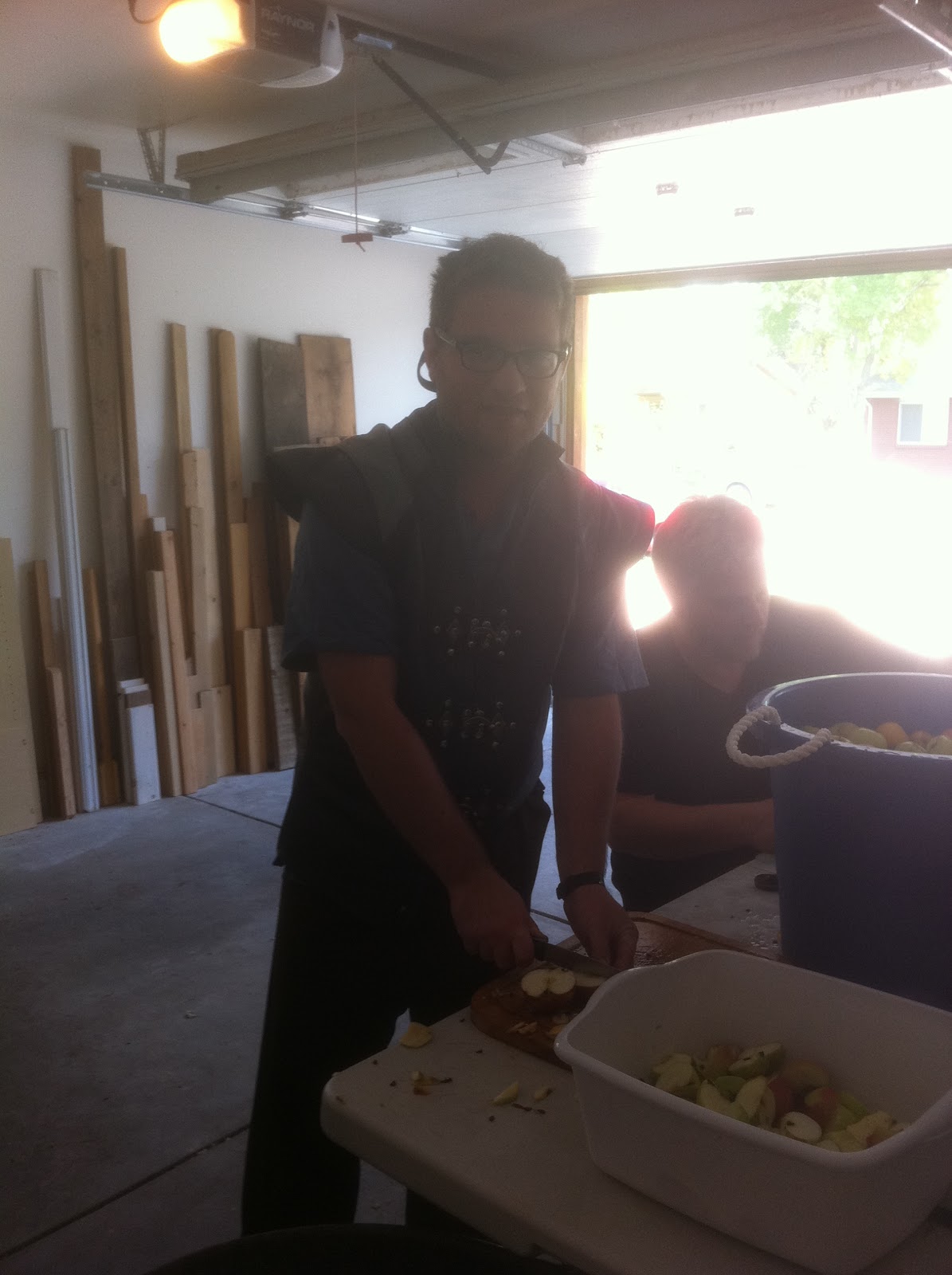
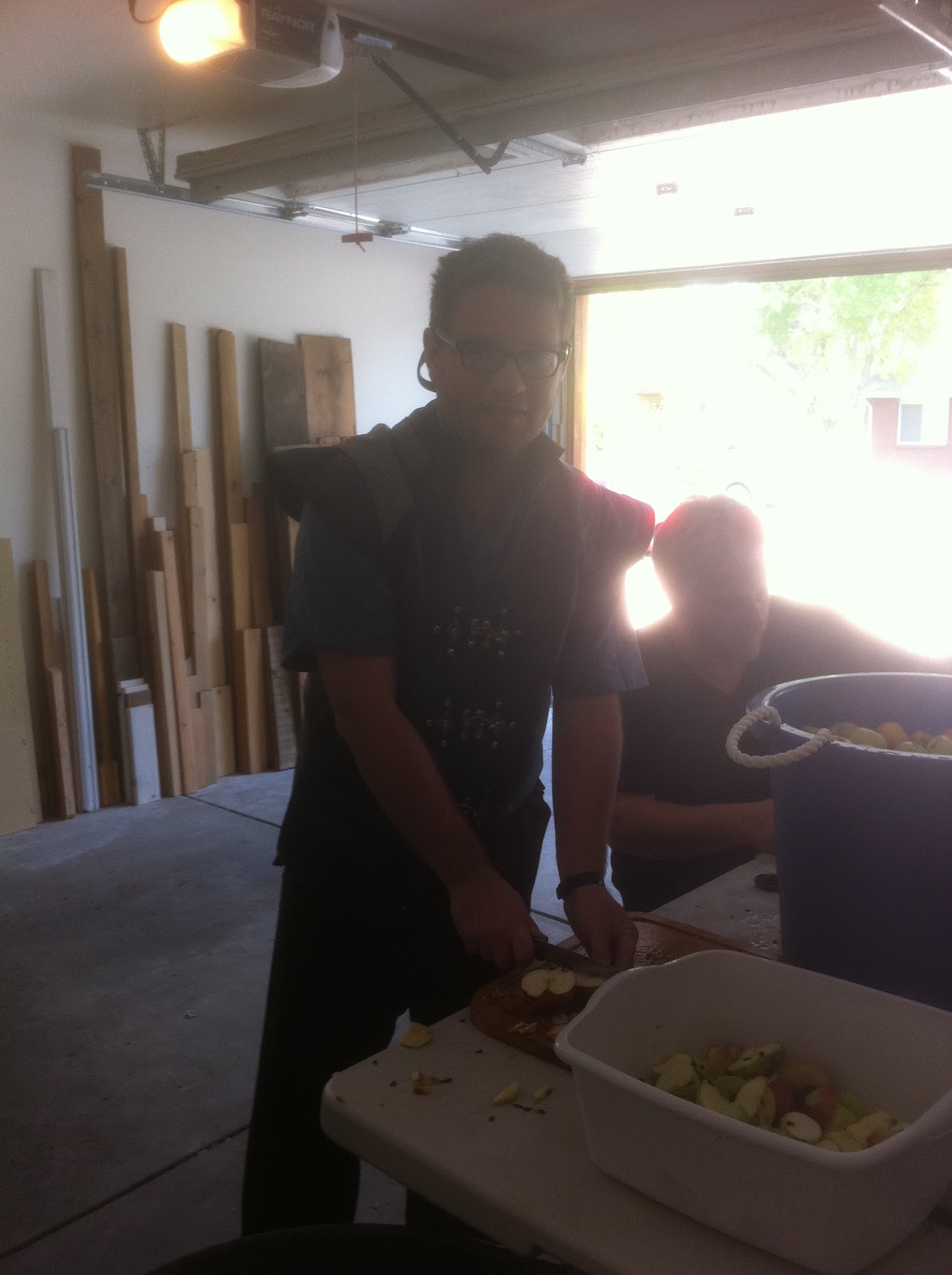
The first step in the process is chopping the apples into pieces.


Most of these apples were picked off of apple trees in the backyard of the person who was hosting this event and some of their neighbors. (We did get permission first.) Since these apples were obviously grown without pesticides, many of the apples were bitten off by birds or partially eaten by worms. This picture shows an apple where a worm has eaten all the way to the center. What we do here is cut off the brown part and throw it away, then use the good part. (Thus we see how apple cider was made before industrialized agriculture.)

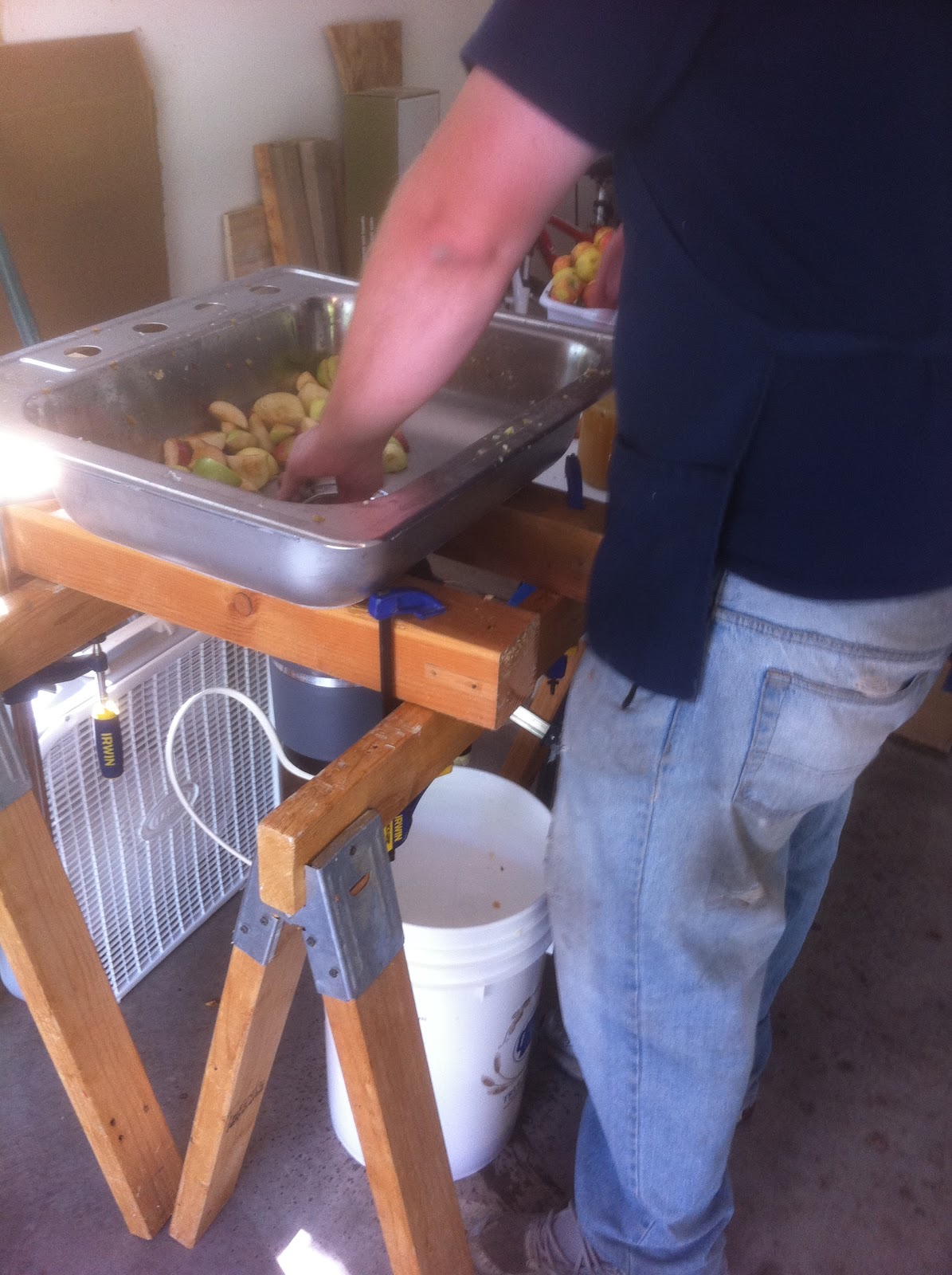
Here we see the apples being ground up into pulp. Not shown in the picture: finished apple cider that is put back into the system in order to keep the grinding machine cool. A couple times during the process we had to shut the machine down because it was starting to overheat.

This is the press that is used to press the pulp into finished apple cider. This is considered "raw cider" because it is right out of the press. Raw cider can also be turned into "hard cider" - an alcoholic beverage made by fermenting the apple juice. The way you do this is add in some yeast, seal the bucket with a "vapor lock" (a valve that allows carbon dioxide to go out but does not allow oxygen to get in) and wait a couple months.

This is the waste product. It includes both the bad parts of apples that were thrown out, as well as what is left of the pulp after the juice is pressed out of it. What do you do with the waste?
Feed it to the chickens!


----


So, anyway, it was fun to see this whole process, but I'm not sure yet whether the SCA is something that I will want to be involved in long-term. My guess is a lot of the A&S stuff would be cool to see in action once or twice, but I just don't see myself putting in the time and effort to really get good ad it. And the SCA group seemed to be a much older group, and they seemed to be less interested in the kind of action-packed fighting stuff that I like. But on the other hand I haven't actually gotten to do fighting with them yet, so I don't know. There is a  "Newcomers" event next month that is supposedly geared toward new players who want to get a taste of the fighting action, so I will make sure to go to that.


Monday, September 3, 2012

Tacticon

This weekend I went to a local gaming convention called Tacticon, in Aurora, CO. The convention was from Thursday to Sunday, although I was only able to get there on Friday evening because I had to go to work. But I did get to play several fun games.

One game I played was "Through the Ages." This is a games that is designed to capture the feel of games like "Civilization" the computer game, in the format of a board game. This game is an economy/civilization building game where you start out with a primitive civilization with only basic technologies, and build up through three "ages" to the present day. This is a complex game with lots of interacting systems. You have to make sure you have enough food to increase your population and get more workers, you have to make sure you have enough resources to build buildings for your workers to work in, you have to produces enough "science points" to play your better technology cards, you have to make sure your people are happy enough that they won't revolt, you have to improve your government so you can get enough actions each turn to do what you want to do, you have to pay attention to your military so you don't leave yourself vulnerable to other player's aggression and war cards. The goal of the game is to collect the most "culture points" by the end of the game; the main way you do that is by building "cultural buildings" like theaters, libraries, and certain "wonders of the world". Since cultural buildings produce culture points each turn, you have to make sure you build them early enough so that you have a chance to accumulate points - but not too early, or you'll divert resources that would be better used building your economic engine. At Tacticon, 9 players (including me) showed up to play Through the Ages, so we split up into 3 games of 3 players each. At the convention there were also prizes available for the winners of each event, but each event was requierd to select one winner, so that meant that we were competing for the highest score against players who were playing at the other tables. (That does change the strategy a little bit; for example there are "bonus cards" that come up near the end of the game that give everyone extra points depending on what they have built. So you might want to play a bonus card even though it gives your opponents more points than you, if you mthink you can still win and it helps beat the other tables.) But anyway I won the game and I got my prize which was a $10 gift certificate to one of the vendors there who was selling board games and dice.

Another game that I got there that I really liked was "Catacombs". Catacombs is a game where one player is the "overlord" and is controlling the monsters, and the rest of the players are controlling the heroes who go to fight the monsters. Okay, so far it sounds like every Dungeons and Dragons type game out there, right? But this is different. The way you fight is that the heroes and monsters are represented by wooden disks, and you flick your disk at the opposing disk to try to hit him. Also, the board have "obstacles" which are holes that you put special gray disks in that don't move; they are there to just hide behind. There are lots of different special powers like ranged attacks (rather than flick your own piece to move it, you keep your piece where it is and flick a special ranged weapon piece), chain attacks (where you can do multiple attacks in a row), and so on. I like this game because it has a significant amount of strategy (how to position your forces to take advantage of the cover, how to maximize the benefit of special attacks) and is also very fast-paced and easy to learn.

Saturday, July 28, 2012

Origins Part 2: "Full Power To Shields!"

Another fun thing I did at Origins was play a couple spaceship themed games. One of the games was called "Artemis: Spaceship Bridge Simulator", a computer game where up to 6 players play crew members on a starship similar to those in Star Trek. There is a separate computer for each station, and a big screen up front that shows a visual display. Stations include comms (who can communicate with space stations to get upgrades and missions, and taunt opponents and demand their surrender), science (who can scan enemies to determine their capabilities and shield frequency), engineering (who is in charge of re-routing power to different systems, controlling the coolant, and using damage control teams to repair damage), helm (who is in charge of controlling the ship's heading and thrusters), weapons (who can fire beams and torpedoes), and there can also be a captain (who does not have a station, but can walk around and give orders to the rest of the crew). The goal of the game is to defend several space stations from enemy ships that are trying to invade. In addition to your primary beam, there are several other weapons including homing missiles, mines, nukes (which have a large blast radius and can take out a whole formation of enemies), and ECM missiles (which can destroy enemy shields). The most successful teams I saw rarely used beams, preferring to stand back and destroy enemy formations by launching an ECM followed by a nuke, and then using homing missiles to mop up any stragglers. (Space stations can build extra nukes and ECMs, and you can convert energy into homing missiles and refill your energy easily, so if you are careful you will not run out of missiles) In the game I played in, I was the helm officer, and we played at a lower difficulty level (3, on a scale of 1 to 11). Our captain, Andrew, came up with a technique he called the "Crazy Andrew": fly at warp speed through an enemy formation, dropping a mine right when you reach the center, then in the couple seconds it takes the mine to blow up you will have moved out of the blast radius. (When you drop a mine, the mine is not moving relative to the game's coordinate system, regardless of how fast the ship is moving when you drop the mine. This game is based on Star Trek physics, not real physics.)

There was another group I watched that was planning a bigger challenge - difficulty level 7 (where 10
is "theoretically impossible", and 11 is "double that"). One of the first groups of enemies they fought, they used the same technique of dropping a mine in the middle of them - except they weren't moving when they did so. So the mine blew up their back of the own ship. Fortunately their ship was in good enough shape to get away and go to another group of enemies, which they tried to beat by firing a nuke - at close range, which blew up the front of their ship. With only a narrow portion of their ship in the middle still undamaged, the enemies easily finished them off. Since the game ended so quickly they tried again. They did a much better job this time, carefully controlling range, using skillful maneuvering to lure enemies into pre-existing minefields, and darting from enemy group to enemy group. But at one point, a mysterious object appeared on radar, heading right toward them! The science station's scanners revealed nothing, and the object kept going toward them no matter where they went. Not knowing whether the object was dangerous, they decided to play it safe and stay away. In an attempt to shake off the pursuer, they maneuvered to put a black hole between themselves and the object, hoping to lure the object into the black hole. The object did go into the black hole, but its path wasn't even affected! The ship continued trying to warp speed away, but they weren't looking closely where they were going, so they eventually ran at warp speed right into their own mine from before! So that quest was over, and the person who had programmed the game, who was watching the whole thing, made a note to fix a bug in the program.

---

Another spaceship themed game I played was "Battlestations", a board game (not a computer game this time) where players are crew on a ship. This game has role-playing game elements, such as skill points and upgradeable equipment, and each time you play it is one mission. Then your character gets experience points and stuff, so you can upgrade it for the next mission. In the game we played, our goal was to warp into a sector of space and investigate a mysterious ship in the middle of an asteroid field. I was a science officer, with the ability to use a science bay to scan the area (asking yes or no questions) and use a med-kit to heal crew members. When we warped in, we first tried to go toward the ship. Normally accelerating too fast makes the ship go "out of control" and gives penalties to your skill rolls, but we were able to mitigate that problem the first round using our "stabilizing fin". (This game isn't based on Star Trek physics: the physics in this game aren't even close to that good.) I used the science bay to ask if there was anything unusual about the asteroids, thinking that they might be hidden mines or something. There wasn't anything unusual about the asteroids, but there was something unusual about the ship. It fired a blue beam at us, which created clones of every one of us, except they were hostile! One thing we noticed was that we weren't able to affect our own clone, so we had to shoot at each other's clones. The clones caused as much havoc as possible, trying to turn our ship off course, shoot at us, and the engineers' clones went through the ship and sabotage our systems. By the end of the first "round" (a round is 6 phases, and a phase is basically a turn), they had managed to sabotage all four of our life support modules. Fortunately we were able to get a couple of them back online before the lack of life support did too much damage.

At the end of the first round, the clones winked out of existence. But this was only a brief respite because they fired the blue beam again, creating more clones! Just before the beam hit, two of our crew launched themselves in a boarding missile to try to board the enemy ship and prevent the beam from cloning them, while everyone else stayed to fend off the clones and heal damaged allies. Near the end of the second round, two of the engineers launched themselves in a boarding missile just before the next beam hit, avoiding being clones but also putting themselves in a position to circle around, come back to the ship, and start repairing systems. By the end of the third round, however, the two boarders (who didn't even have "combat" as their primary skill) reported that they had shut down the beam and taken control of the enemy ship, ending the mission in success. You see, the enemy ship had a very powerful beam weapon, but it didn't really have any defense.

Thursday, July 5, 2012

The Health Care Law

So, a couple weeks ago was the Supreme Court decision about whether the individual mandate to buy health insurance in PPACA (also known as Obamacare) was constitutional. It turns out, it is, but not for the reasons you might expect.

There were basically two main issues. One is where the "Commerce Clause" - the power given to the federal government by the Constitution to regulate "interstate commerce" - covers the health care law. The other was whether, even if the Commerce Clause doesn't apply, the individual mandate can also be considered constitutional because it is a tax, and thus falls under the government's power to levy taxes.

It was a close 5-4 decision in favor of the law, and the swing voter, Chief Justice John Roberts, wrote in his opinion that the Commerce Clause does not apply, because in order to "regulate interstate commerce" there first has to be commerce to regulate, and people who don't want to buy health insurance are those that are not engaging in any relevant commerce in the first place. One counter-argument to this is that people who aren't insured will still eventually need health care and end up "engaging in commerce" sticking others with the tab. Roberts rejects this argument, because the fact that someone might engage in commerce at some point in the future doesn't justify forcing him to now. For instance, all of us will buy food at some point in the future, and the government can regulate food sales, but the government can't force me to go to the grocery store right now and buy a specific food item.

However, Roberts does cast the deciding vote in favor of the law's constitutionality on the grounds of the Taxing Clause - that it can be viewed as a tax on not having health insurance, and the government has the power to levy taxes. PPACA states that anyone who does not have health insurance must pay money to the IRS along with their normal federal taxes. Although PPACA does not call it a "tax" - it calls it both a "penalty" and a "shared responsibility payment"*, legal precedent requires that "every reasonable construction must be resorted to in order to save a statute from unconstitutionality" - i.e. if you could make the statute constitutional by re-wording it a bit, then it's constitutional.

One issue that was not discussed in the opinions was the following. Let's say that instead of saying that you have to pay a penalty of $X if you don't buy insurance, the law just raised everyone's taxes by $X across the board, and additionally said that if you do buy insurance, you get a reduction in $X on your taxes. That certainly seems like another "reasonable construction" that is functionally equivalent to the existing law. And it is very clearly constitutional: The government obviously has the power to raise taxes, and the government gives tax breaks to encourage you to buy/do certain things all the time (buy a house, get married, etc.) and nobody claims those are unconstitutional. (I am not the only one to notice this.)

As far as the Commerce Clause part goes, a major argument against constitutionality was as follows. The idea of the individual mandate is that people not buying health insurance imposes increased health care costs on others, so the government can mandate that people buy health insurance. So by that logic, since people eating unhealthy foods also increases health care costs, that means the government can mandate that everyone buy fruits and vegetables. (One version of the argument specifically mentions broccoli, although that was not part of the final opinion.) And since the government mandating that everyone buy broccoli is clearly an unconstitutional government overreach, mandating that everyone buy health insurance is similarly unconstitutional.

Here's my response to that argument:

First of all, why is it so obvious that the government forcing us to buy broccoli is unconstitutional? Again, suppose the government were to raise our taxes, use the proceeds to buy broccoli, and then provide it to us for free. Clearly each step in this process is constitutional, and the result is economically equivalent to making us buy broccoli, except with extra overhead.

But a better way of analyzing this question might be to think about why we have constitutional limits on government power in the first place. The point of such limits isn't to prevent the government from doing anything that might be a bad idea. There are lots of things the government can do that are clearly bad ideas (say, raising everybody's tax rate to 100%) but that the government clearly has the power to do. The thing that protects against these kind of bad policies is that if politicians enact bad policies, their constituents can vote them out (of course, it's not clear how well that incentive works, but at least that's the theory.)

Rather, the purpose of constitutional limits is to stop the government from doing things that are politically popular (or are inclined to do anyway for other reasons) despite being bad ideas. In other words, things that we expect the government to be over-eager to do in comparison with the actual merits. For example, consider free speech. We know that governments can be particularly eager to restrict speech, both because such restrictions can be politically popular in the short term (especially since it can be hard politically to defend the right of people to engage in unpopular speech without appearing to endorse the content of the speech) and because it can be used to squelch criticism of government. That is why it is important to make sure that the government can't easily prohibit speech. Another example is the prohibition against unlawful searches and seizures (and other limits on police power.) We know that police would likely search more intrusively than is warranted in the absence of such protections (again, because most decisions about how to search are made by individual police officers, who are not as subject to political discipline, and because it can be difficult politically to advocate for less intrusive searches without being accused of helping criminals) so it makes sense to have those limits.

So, is the power to force people to buy things a power that government has the tendency to overuse? I don't think so (at least, not more so than other government powers that nobody claims are unconstitutional). The main argument that I tend to see for why the government would overuse the power to force people to buy things is that it could be used to give favors to special interest groups. For example, if Big Broccoli gives a lot of money in campaign contributions, it could "buy" a law that forces people to buy broccoli, irrespective of its actual merits. However, I think that the risk of this happening is significantly LESS than the risk of providing favors in other ways (e.g., subsidies to broccoli producers), because forced purchases are a significantly MORE transparent and publicly visible way of providing political favors than are other methods such as tax breaks and subsidies.

In other words, if the government is going to give away political favors to Big Broccoli, I would much rather that they do it by making everyone buy broccoli, because that way everyone will know what is happening, and we can have a political discussion and ensure accountability. In contrast, giving political favors the current way (like hidden tax breaks and subsidies) is much more problematic, because most people don't know who is being given what special favors, so there isn't as much political accountability.

But anyway, I am glad that the health care bill has passed and been ruled constitutional, so that we can find out what's in it.**

-------------------------------------------

*I really have to find a clever way to use this wonderfully euphemistic name for a tax. Maybe in Dungeons and Dragons, when the evil king taxes his people to get money to raise an undead army to conquer the world, he could call the tax a "shared responsibility payment." I mean, raising corpses from the dead counts as health care, right?

**I think that Pelosi has a very good point here, even if she expressed it using a poor choice of words. Before the law is actually implemented, it is very easy to come up with all sorts of scare stories - like the whole "death panel" thing and stuff. But once it is actually implemented, after a few years we will be able to tell whether any of those scare stories came to pass. I believe that once we actually see how it works, people will like it. I mean, my understanding is that most people who are on Medicare like it, even if they don't realize it's a government program.

Wednesday, July 4, 2012

Origins Part 1: Mage Wars

Last month at Origins I played lots of fun games. One of the games I liked the most was a game called Mage Wars. It has not come out yet; they are planning to release it soon. The game simulates a battle between two dueling mages, similar to Magic: The Gathering. Many of the game mechancis are similar: you can summon creatures and cast spells such as fireball to destroy you opponents. But there are lots of cool new features, such as the fact that there is a board consisting of a grid of zones, and you can move your creatures and mages around on the board to jockey for position. Another big difference is that unlike in Magic, where you can only use the cards in your hand, in Mage Wars you can use any of the cards in your spellbook (which is like your deck). That gives you a lot more options each turn and limits the amount of luck, but also makes the game take a lot longer than a typical Magic game. The first day I played this game I went and did the demo, and played against one of the people who worked there. I chose the "Wizard", a mage who specializes in controlling the battlefield, improving his mana generation capacity, and draining his opponent's. ("Mana" is magical energy that you use to power your spells.) My opponent chose the "Warlock", a master of fire who specializes in burning his enemies to death. As the game started, my opponent rushed forward and pummeled my Wizard with a barrage of fire spellls, damaging him and catching the creatures that I had just summoned within the blast. I quickly switched to a defensive posture, putting fire-resistant armor on my wizard and moving creatures forward to attempt to drain his mana. Since my opponenet had run out of direct-damage fire spells after the initial barrage, he pressed the attack by summoning creatures, and my own creatures were sent out to meet them. The battle continued for at least a couple hours, and the rest of the Mage Wars demo team was getting ready to pack up and go home for the night. Soon my opponent dug deep into his spell book and pulled out what he thought would be the killing blow - an enchantment that would cause my mage to rot, taking damage every turn. But he didn't anticipate my counterattack - a spell that would shift that enchantment right back onto himself! With no other counters in his arsenal, my opponent's mage quickly rotted to death. The next day I went back to compete in the Mage Wars tournament - a four-round, single elimination tournament. We were each given a random pick from the set of four mages - I got the Wizard, as I had used before. This tournament had a 50-minute time limit per round, and once the time limit is over you play until the end of the current round and whichever person has the least damage on it is the winner. During the first round the game was going slow, and when the "one minute warning" was called we were still solidly in the middle of the game. My opponent had less damage but I was in better position to attack with creatures, and I just needed one more turn to win. Fortunately my opponent didn't have any remaining actions for the a round, so I was able to rush through the rest of thr round with my creatures and move on to the next round before time was called. The next three rounds were also fairly close, and they all went to the time limit, but I squeaked out a victory in all of them to win the tournament. After the tournament one of the people who worked there gave me a business card and said to contact him if I wanted to be a playtester. After the convention I wrote to them, and suggested possible additions to the game to make sure it doesn't drag out so much. - after all, as players get better at the game and develop more sophisticated strategies, it is likely that it will require more analysis and make the games take longer. They thought that my ideas were so good that they made me an official playtester for the game, and gave me the opportunity to look over their spells and rules before release and offer feedback. (That's why it's been taking me so long to get around to writing this blog pots - because I have been so busy looking at all the cards!) Since the cards haven't been released yet I am not supposed to talk about specifics, but you will see soon enough once the game gets released!

Sunday, July 1, 2012

What We Have Here Is A Failure To Communicate

Yesterday I went to the park (Lee Martinez Park) for Dagorhir, and I was the only one there. This was the second time in a row that I had been the only one there, so I asked on the Facebook page for the group about whether it had been moved or canceled. Nobody seemed to know; I was told the name of the person who was supposedly running the event, but he had no publicly accessible phone number posted, and none of the other people on Facebook seemed to know how to contact him. Eventually I was able to find out that the reason was that it had been moved to another park (Rolland Moore Park) in Fort Collins, but that information had not been posted anywhere on Facebook or the web site and had only been passed on by "word of mouth". The only way I was able to find out was that I knew that one of the people at our park had wrote a book about battle gaming, and I was able to get his phone number off the web site for his book.

What is really confusing to me is why they distributed the information this way rather than taking the 15 seconds or so it would have taken to make a post on Facebook. Clearly the "word of mouth" method wasn't very successful; lots of people in our Dagorhir group didn't know about it. (On the other hand, I was the only one who showed up at Lee Martinez park, so maybe that means that everyone but me did in fact get the message. I think that could be because they have practices in Fort Collins and Loveland, and the people on the Facebook page are primarily those that go to the Loveland practices.) It is surprising that they would choose a method for distributing the informaiton that takes more work AND is less reliable than posting it on Facebook or the web site.

And in terms of recruiting new players (although I'm not sure how high a priority that is for them), it certainly doesn't make a very good first impression when the person supposedly in charge has no publicly available contact information, and it's not easy to find where they actually are. I was walking in downtown Fort Collins with all my stuff (arrows and bow) on my back, and a couple people were interested in what they were, and I told them about Dagorhir and that it was in Lee Martinez Park. If there's nothing publicly posted that says that that's been changed, then it's going to be almost impossible for anyone new to find our Dagorhir group.

Saturday, May 5, 2012

More bad math in the news

Ann Coulter on immigration:

Nearly three times as many Americans support reducing immigration as want it to stay the same, according to Gallup polls. A grand total of 5 percent of the population want to increase legal immigration -- 10 times less than want to decrease it.

 In other words, 50 percent of Americans want to decrease immigration, 17 percent of people want immigration to say the same, and 5 percent of people want to increase immigration. What about the other 28 percent?

Monday, March 19, 2012

Credit checks and employment

An article from the Fort Collins Coloradoan caught my eye, in part because it deals with a similar issue to the "avoid ghetto" GPS app: whether giving more information can make people worse off.

The article discusses efforts by Colorado lawmakers to prohibit businesses from running credit checks on prospective employees and using the results in hiring decisions. Obviously, the reason employers run these credit checks in the first place is because they think the people with better credit tend to be more responsible and thus better workers, as well as being less likely to steal from the till. The argument for banning such checks is that they can create an "unemployable class" of people because people can't improve their credit without income and can't get a job unless they have good credit, and also that it's possible to have bad credit even if you are financially responsible (say because of a layoff).

The readers' comments are predictable. Most of them say that it's just wrong for employers to "discriminate" based on credit checks, while there is a minority view that the government should not have a right to tell businesses how they can make hiring decisions. (I would like to point out the comment by Jeff Emmel, in the first category, which blames the problem on "too many people chasing too few jobs." If true, this seems to negate the idea that credit checks are the problem. If there are N people looking for a job and there are M openings, then at least N-M people will fail to get a job, regardless of what methods are used to screen applicants.)

Here is my analysis. A traditional economist would likely say something like the following:

If credit checks really provided no useful information about the quality of an employee, businesses would have no reason to use them. Any business that did use them anyway for whatever reason would face a competitive disadvantage in the marketplace because they would be screening out qualified employees, and a business that didn't use credit checks could gain an advantage by grabbing all the good employees that were rejected by others. Thus, if the practice really has no benefits, there is no need for a law against it; it will die out naturally. If it doesn't die out, that is evidence that it is in fact providing useful information.

Of course, exactly the same argument was made with race, gender, etc. discrimination laws, and look how that turned out. But this case is different. The difference with racial discrimination was that customers had a preference against minority employees so businesses reacted to that, but we needed to get minority employees into restaurants and stores so that people would learn to overcome their prejudice. In this case, customers neither know nor care about the credit histories of the employees with whom they interact. Also, credit checks are a relatively new thing in employment, so unlike the issue with race discrimination, we're not starting from a status quo where everyone discriminates so nobody has a chance to realize what they're missing out on.

One could argue that it really is true that people with poor credit tend to not be as good workers, but that there's a public benefit to giving those people jobs that outweighs any harm done to employers. This position is not unreasonable; after all, someone who is consistently poor does cost society money to maintain because they are more likely to need welfare and other social services. But it is important to realize that this argument only applies if there is a greater public benefit to giving a poor-credit person a job than giving whoever the replacement would be a job. And most importantly, if there really is a public benefit to giving particular people or classes of people jobs, a better way to do it is with subsidies and incentives targeted at that group and let businesses decide whether the incentive is worth the cost, rather than through the indirect way of banning credit checks.

However, I can also think of several counter-arguments to the above.

1. It may be true that the practice will die out eventually if it is not providing useful information, but that could take a significant amount of time. In the meantime, many people will still be affected.

2. Let's say that half the people who have poor credit really are financially irresponsible, but the other half have poor credit for reasons completely out of their control. Then it makes sense from the businesses' perspective to avoid the risk, but the innocent half is still caught in the crossfire. (However, the arguments in the last paragraph above still apply.)

3. Suppose that it is possible to "manipulate" your credit rating*. Then everyone will manipulate their rating in order to get a better chance, but of course all this manipulation is a zero-sum signaling game, so it's a waste of effort. (If everyone manipulates their rating up by X points, then everyone is still in the same order so it gives exactly the same information as before, but nobody ends up better off.)

4. As for the comparison to racial/gender discrimination laws, there's another consideration which cuts the other direction. One problem originally identified with racial/gender discrimination laws was that it's essentially impossible for a business to prevent itself from obtaining information about an applicant's or employee's race or gender. Thus, for instance, a business might want to fire an unproductive worker but might have a difficult/expensive time proving in court that the firing was not because of race/gender, so it might decide not to. In contrast, it is very easy for a business to avoid obtaining information about an employee's credit history, so this is a non-issue.

5. It may be possible that there is a public benefit to giving jobs to certain classes of people - which tend to overlap with the people who have lower credit scores - but the first-best solution of "subsidies and incentives targeted at that group" is impractical due to other constraints such as political feasibility. So banning credit checks could be a good "second-best" solution.

---

Perhaps surprisingly (but maybe not), very few of the comments in the article itself or the reader's comments directly address any of the questions above. I wonder why?


*This "manipulation" need not be anything shady or illegitimate. The only thing relevant for this analysis is that the "manipulation" has no relevant effect other than improving your credit score. Given all the advice about "how to improve your credit score" that you can find all over the place, it's very likely that this type of "manipulation" is possible.

Saturday, March 17, 2012

Crusade of Legends

Last weekend I participated in a new LARP called Crusade of Legends. It didn't have nearly as much fighting as most of the other LARPs, but it was interesting in its own way.

When I got there, I had originally planned on being an NPC (non-player character) - in other words, I would play the monsters. I hoped to learn more about the game before deciding which character class to be. However I soon discovered I didn't want to do that, as after about an hour and a half of playing an NPC, I had spent about an hour and 25 minutes of that time just waiting in the "NPC" camp waiting to be called out. So instead I decided to switch to being a player character, and I created a character - a "sorcerer" who combines magical powers with melee combat - and rejoined the game.

Next, I got caught up to speed on some of the events of the day. I had learned that I had just missed an enthralling speech by the governor about taxes, and that there were goblins threatening the town. Speaking of taxes, the governor also told me that I would have to pay a piece of silver in order to become a citizen, and only citizens were allowed to brandish weapons in the town. (The money system is 1 gold = 10 silver = 100 copper, and all new characters start off with 5 silver.) I asked what happens if I wasn't a citizen and a goblin attacked me, and he said in that case I would have to retreat and find a citizen who could defend me. So I decided to just pay the money to become a citizen, and continued on.

Soon there were rumors of intrigue going around. A group of adventurers had gone into a "white maze", and when they came out they refused to talk about what they had seen. Also, there were stories about a "lich king" that was threatening the village, and the governor as well as a select group of guards were planning on going there to negotiate. Also, there were apparently some "shades" that were planning on coming out at night, and only special "magical light" spells and weapons could harm them. Of course I didn't have that, being just a new character, so I wasn't able to participate in any of these battles.

I did go out in search of adventure for a little while - someone else had told me he found a mysterious gem - a component for certain kinds of powerful "formal magic" spells - lying on the ground. We searched around for more such components, but the search was fruitless - there were no more components, and we didn't run into any goblins or other monsters. As night fell, I went back into the tavern, to have dinner and drinks (not alcoholic ones, of course) and learn more about the events of the day. I heard the governor and treasurer talking about the town's finances - apparently they were in debt to the lord from whom they bought the land to set up the town. They were discussing a proposed tax of 2 copper per month per citizen, or a total of 4 silver per month for the total population of 20 citizens. Also, the captain of the guard needed guards for the night. He needed two guards in each of three shifts - 8:00 PM to midnight, midnight to 4:00 AM, and 4:00 AM to 8:00 AM, and was paying 2 silver, 6 silver, and 4 silver respectively for each of those shifts. I wasn't exactly sure how the town as going to get the total of 24 silver (actually, 36, because I think they ended up hiring three guards instead for each of the shifts) with only a total tax revenue of 4 silver, but apparently there is some other source of money I didn't know about. Also, I learned about a protection spell that could be cast on the tents and the tavern in order to allow us to sleep in peace - the way it worked was the spell could be cast at any time, and the protection would be in effect from 2:00 AM to 9:00 AM. I asked why they needed overnight guards if they had the protection spell, and he said that it was necessary because the enemy might have ways of dispelling the protection spell. Sitting outside in the cold for 4 hours overnight didn't really appeal to me, so I decided not to take the guard job.

Instead, I spent the night in the tavern listening for more information. I also found a deck of cards lying on the table, so I played a gambling game with a fellow patron (which I will talk about in another post). But I did get to see some interesting stuff going on. A "Grand Inquisitor" and her minions came into the tavern to find out what we knew about the "malediction" that was apparently sweeping the lands, but she also aroused some suspicion when she asked us not only about the malediction, but also about our respective fighting styles. Also, the governor temporarily kicked us out of the tavern without explanation for a meeting that was going on inside the tavern, and while we waited outside one of the other people kicked out tried to convince us to go back in, assert our rights, and demand an explanation. The meeting ended before we decided whether to do this, but we later learned through the grapevine that the topic of the meeting was fairly innocuous (something about a "traveler's guild" that wanted to set up shop) and not anyone plotting against us or anything (although we didn't really understand what was so secret about it).

Also, a couple interesting issues came up. Apparently, two priests had abandoned the god to which they originally worshiped and tried to switch to a different god for the purpose of getting the powers of the new god to help defend the town against the "lich king" and potentially other threats (I wasn't sure of the full details). However, after abandoning the first god, the priests discovered that they needed to make a "blood sacrifice" to gain the new god's power. Somewhat surprisingly, it was fairly easy for them to find people who were willing to be sacrificed*. However, they were later put on trial for murder, and the magistrate got together a vote of the town's citizens, who voted to change the law to allow for legal blood sacrifices (as long as the victim is willing, of course). This decision was not without controversy as some thought that blood sacrifices were inherently evil. Another in-game legal issue came up the next morning, when an orc charged into town brandishing a sword and demanding the return of a special glove (again, I was never sure what was so important about the glove). Some citizens quickly ambushed and killed the orc, and there was some discussion over whether or not that act was legal self-defense. The magistrate said that it was, but another citizen said that it wasn't, because, as he pointed out, the town laws define assault as "an action to harm" someone else. Thus, according to this definition, assault would require actual harm, so for instance if you swung your sword at someone and missed, it wouldn't be assault. Thus, the orc had not yet committed any crime, so it was not legal self-defense to kill him. Thus citizen said that if the magistrate meant for a situation like this to be self-defense, he should change the law to include something about "intent to harm" in the definition of assault.

------------

Overall, I thought that this game was very different than any of the other ones I have participated in. One negative about this game was that it seemed like I wasn't able to participate in most of the action - I observed a lot of interesting things (as I described above) but I didn't get to do much actual fighting, and I never got a chance to go into the maze, go to the negotiations with the lich king, participate in the discussions about finances or the traveler's guild, etc. In some sense this seems like just the nature of the game - you can't expect to just walk in and participate in high-level discussions about (in-game) politics in the way that you can just walk in, pick up a (foam) sword, and start fighting. I also noticed that most of the fights were very one-sided - any monsters that attacked us just died within moments, and never posed much of a threat. (This is in contrast to when I played Nero, where there were a lot more monsters that came in waves, so we really felt besieged and had to manage our resources well to defend ourselves.) In the car going back, I pointed that out, and was told that the point of the monsters was to advance the story, not really to pose a threat. I was told that it was a good idea to come back, because as I participate more "plots would develop around me" and I would get more of a chance to participate in the action.

I probably will go back, although I'm not sure exactly when. There was a lot of exciting stuff that happened, but whether this is a game that I want to stick with long-term really depends on whether the promised "plots" actually materialize, and how good they are. Also, I learned that there is a Nero gropu that is running an event March 23-25, and I will try to make it to that one. Nero seems like it might align more closely with what I want, because it has the "you're in character for the whole event" thing as well as lost of role-playing and story, but also has a lot more combat.

That's enough for this post, but I'll try to post more posts in the next couple days where I explain the gambling game I learned as well as more discussion of the legal issues mentioned above.

*In this game, if you die, you can easily get resurrected at a resurrection circle. On your third and subsequent deaths - and the deaths do accumulate from event to event - you have to draw a bead from a bag and risk getting permanently killed and having to make a new character, but the level of combat is low in this game so it is relatively easy to avoid getting killed if you are at risk. Also, it is possible, if you are a human character, to purchase a special power that allows you one "free" death per event.

Tuesday, March 6, 2012

Oil subsidies

The article "Time To Put An End to Big Oil Subsidies" by Allen Greenberg, in the Northern Colorado Business Report, draws a contrast between farmers, who have stated their willingness to forgo subsidies in a time of high deficits, and oil companies, who want to keep their subsidies. While I generally agree with Greenberg's position that oil subsidies should be reduced or eliminated, there is one sentence in there that does not make much sense: "it should be easy to recognize that subsidizing a profitable business simply makes no business sense." This does not seem correct to me. The point of subsidizing something is to increase the maount of it, so it can potentially make sense to subsidize anything you want to increase the amount of - whether it is currently profitable does not enter into it. (In particular, assuming efficient markets, in an equilibrium condition any productive activity has a net profit of exactly zero on the margin - if the marginal profit was positive, people would do more of it; if the marginal profit was negative, people would be doing less of it. Putting in a subsidy makes it more profitable, which leads people to do more of it until it's not more profitable anymore.)

Also, a policy of only subsidizing activities which are currently unprofitable could easily have perverse effects. For instance, companies might deliberately try to be less efficient so that they would be "unprofitable" and thus deserving of subsidies.

EDIT: Link to article is here.

Sunday, March 4, 2012

Returning to the battlefield, part 2

This weekend I went to both Dagorhir and Amtgard. I had a pretty good time at Dagorhir, although unfortunately the "new angle on the action" had to be postponed due to technical difficulties.

My experience at Amtgard was far more mixed, however. The play-test had to be cancelled because the people who were supposed to be running the play-test were coming down from Wyoming, and it was too windy for them to make the drive down here (apparently part of the interstate was closed, because the wind was so powerful there was a risk of blowing cars off the road). Fortunately there wasn't much wind down in Fort Collins so we were able to do some fighting. Unfortunately there weren't that many people there, so all we could do was some ditch fighting (melee only). So that wasn't my favorite. Apparently this Amtgard group mostly doesn't like doing battlegames unless there are lots of people there, and they rarely get that many people except during the summer. But I did tell them about some of my ideas for some battlegames that you could do with fewer people, and they thought that my ideas could be good and that I should run for Champion so that I can put my ideas into practice (currently there is a bit of a "power vacuum" and they don't have any Champion at all).

I also got to look at some of the new 8.0 rule changes (even though I didn't get a chance to play with them) and there are lots that look interesting. Arrows are much less effective against armor, but archers also get lots of special arrows and powers (like "Reload", which lets them "go insubstantial" and go around the field unhindered to retrieve their spent arrows) that make up for that. Another big difference is that they are planning on removing most, if not all, of the abilities that require you to pretend not to notice things. For instance, in the current version there is a "Teleport" spell that allows you to move to somewhere else on the field, and you "cannot be noticed" while in transit. I strongly dislike these abilities for the following reasons:

1. There is too much room for interpretation regarding what is and is not permissible. (If you see someone teleport, and they are moving toward a game objective, are you allowed to go toward that game objective to defend it on the assumption that even though you didn't notice him, you could guess they are going for the objective? Or can you not go defend the objective at all?)

2. There is too much room for argument on whether a particular action was legal. (Did he go over there to get away from the teleporting guy, or because he was going to attack someone else?)

3. It's actually very difficult to behave exactly the same way as you would had you actually not noticed him. (If you hear someone behind you, you'll naturally start paying attention that direction just by instinct.)

4. It rarely leads to interesting game play. For me, at least, the interesting game play part of these types of "secret movement" mechanics is the guessing and keeping you on your toes: Where do you think he went? What could his plan be? how can you protect yourself from all the possibilities? But if you actually know where he went and just have to pretend not to, that whole "mind game" aspect is lost. The question becomes not "Can I anticipate what he will be doing" but rather "Can I justify doing what I want to do without reference to knowledge of where he is moving towards?"

In general the whole thing makes me think of those philosophical paradoxes about what it means to "intend" to do something (because you can't move somewhere for the purpose of responding to the teleport, but you can do it for some other reason). Which isn't necessarily what I want to think about in the heat of the action.

I'm really looking forward to Crusade of Legends next weekend. I think that they will do a lot more of the things that I actually like (with spellcasting and powers and such) and they are more story-based, so it's more likely there will be interesting things to write about on this blog.

Tuesday, February 28, 2012

Returning to the battlefield

I went to some LARP groups when I first moved out here, but I haven't been to any of the LARP groups recently, because the Amtgard group in Fort Collins tends not to do the battlegames that I like during the winte r(they just to melee only fighting, which is my least favorite part of the game) and the Dagorhir group meets on Sundays in Loveland, and Sundays are the one day the buses don't run. But I just learned that Dagorhir started doing practices in Fort Collins just a couple blocks away from the bus stop in downtown Fort Collins, so I started going there. I got to be an archer like I usually do, and it was a lot of fun. Also, the people there just generally seemed to be a lot nicer and more helpful than the people down in Loveland.

(One time, the people in Loveland told me that my arrows didn't pass the safety inspection, and the person in charge said that if I gave her my phone number, she would call me and we could set up a time for her to teach me how to make arrows. I knew there was a really good chance that she would forget to call me back, so I asked for her phone number, but she refused to give it to me, saying that she would just call me. Of course, she never did. And by the way, the person who had agreed to take me home that day left without me, so I had to take the $35 cab ride home. When I brought those same arrows to the people in Fort Collins they said they didn't know why the Loveland people didn't like them.)

On Sunday there was supposed to be another special event - a playtest for the upcoming 8.0 version of the Amtgard rules, up in Cheyenne, WY. I had contacted someone from the Fort Collins park who said he was going and he could take me there. On Sunday about an hour before we were supposed to go, he said that he had heard from the person in charge of the Fort Collins park that it was canceled because of the wind. I contacted the Cheyenne park through Facebook and learned it was not canceled. I then called the first berson back, and learned that he had no idea I even wanted to go to Cheyenne - the whole time he thought I had just wanted transportation to the Fort Collins park! As it turned out, not many people showed up to the playtest so they scheduled a new one for next Sunday - at the Fort Collins park.

There are also a few more LARP events coming up in the near future. One is "Crusade of Legends", a new LARP system that I have never played before, that is in the area near Boulder and Denver, and they have an event on March 10.. Another one is "Core LARP", which is somewhere to the north of here. They are supposed to have an event every month, but the one in February was canceled because of snow, and the one in March is supposedly being rescheduled tdue to scheduling conflicts at the site. At th ebeginning of April, the Dagorhir park in Loveland is having their "Season Opener", when supposedly there will be a lot of people there from all over the area. I will probably go to that one, and hopefully my experience before won't be repeated.

And one more thing - for my upcoming posts about LARPing I have something new in store. I won't provide any details as of yet, but I will tell you that there is a chance you will get a new angle on the action like you've never seen it before.

Saturday, February 25, 2012

Pictures from Genghis Con

This picture was during the game of Zendo in which I was the "Master." Green stones indicate koans which have the Buddha-nature; red stones indicate those that don't. (The black card labeled "Zendo" is the koan that contains no pieces.) Can you figure out what the rule is?


As we've discussed before on this blog, dice superstitions are rampant in gaming circles. This "Dice Dungeon" is a prison used to punish dice that are rolling poorly. (It might actually work: after all, if you put poorly rolling dice in here, it is in fact true that when they come out, they will on average roll better in the future.)

On the other hand, when superstitions fail, one can always use more effective methods: